Part 6: Why You Must Share 'Drafts, Not Decrees'
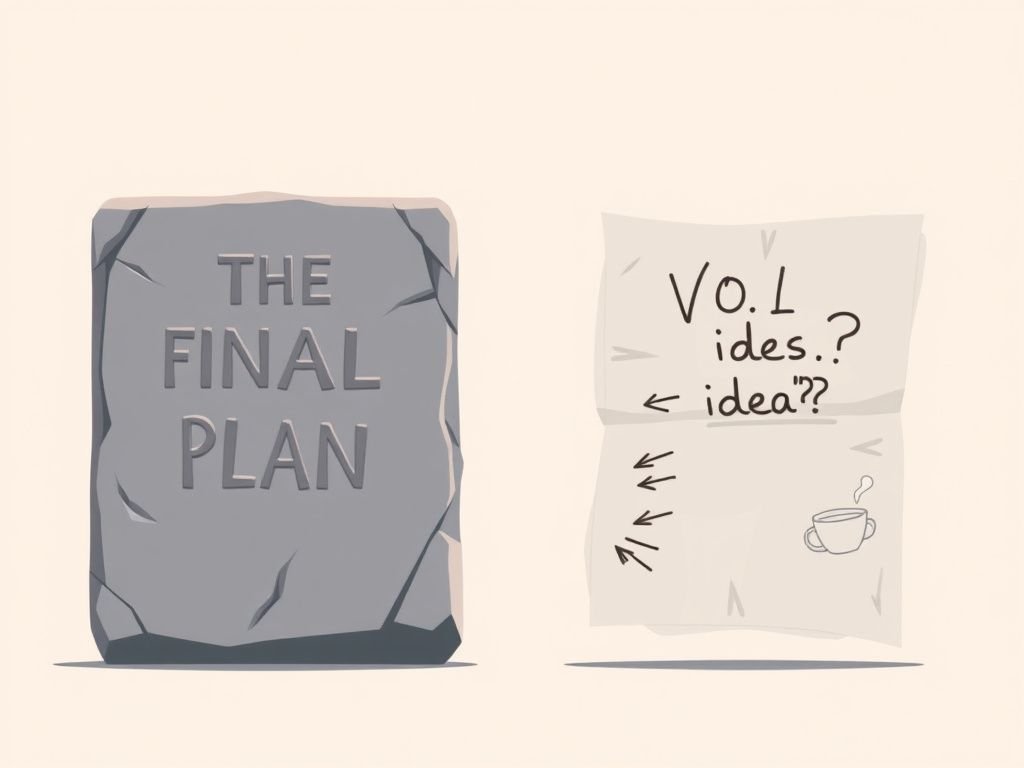
If you want to invite engagement, you have to change *what* you share, not just *how* you share it. Many leaders inadvertently create lip service by asking for feedback at the wrong time.
The Problem: You spend two weeks in a cave perfecting a 30-slide deck or a 10-page "Final Plan." You present it to the team and ask, "Any feedback?"
The Result: You get the "Quiet Room" or the "Vague Yes." Why?
- It's Terrifying: The plan looks "finished." People are afraid to "break" your beautiful, polished thing. To challenge it feels like a personal attack on your two weeks of work.
- It's Too Late: People know the decision is already "baked in." You're not asking for "feedback"; you're asking for "praise." Any feedback given now is just a nitpick.
You've presented a Decree . What you should have shared was a Draft .
The Power of the "V0.1 Strawman"
A "draft" is a psychological magic trick. A "Final Plan" triggers a "pass/fail" judgment. A "draft" invites a "creative, collaborative" mindset.
People *love* to fix a broken thing. They are terrified of breaking a "perfect" thing.
By sharing a "V0.1 Strawman" or a "Rough Draft for Discussion," you are signaling:
- "I don't have all the answers."
- "This is not (yet) my ego."
- "I need your help to make this better."
This is infinitely easier to critique. It's not a challenge; it's a collaboration.
How to Do It (A Tactical Guide)
-
Label It:
Never, ever send a doc called "The Plan." Always use a label that *invites* destruction:
- "V0.1 Strawman"
- "Rough Draft - Please Poke Holes In This"
- "For Discussion: Messy First Pass"
- Share Early, Share Often: Share the "messy" version *before* you've fixed all the typos. Share it when you're only 60% sure. This builds trust and proves you're not just looking for validation.
-
Be Specific in Your "Ask":
Don't just say "Thoughts?" That's lazy and invites no response. Be specific about what you're worried about.
"Hey team, here's the V0.1 draft for the launch. I'm least confident about Section 3 (Rollout). I feel like I'm missing a big risk. Could you all take a look and poke holes in my logic there?"
This gives your team a specific, safe mission. They're not "attacking your plan"; they're "helping you find the risk in Section 3."
Stop trying to be the "smartest person in the room" who delivers perfect decrees. Be the "most useful person in the room" who shares messy drafts and invites the team to build the solution *with* you.